
Caribou County VINE Coverage
VINE means Victim Information and Notification Everyday. Idaho provides it through VINELink’s Idaho search. The Idaho Sheriffs’ Association maintains interfaces with jail booking systems across the state and with the Idaho Department of Correction. Caribou County’s own sheriff links VINELink from both its homepage and its detention page. That local endorsement matters because the sheriff publishes no searchable custody roster or recent-release archive.
VINE can report a source agency, current custody status, facility or location, and a recent event such as release or transfer. A scheduled date may appear when the supplying agency sends one. County jail data and IDOC data can both reach the system, but they represent different kinds of custody. A Caribou County booking may end in community release, while an IDOC event may reflect prison movement or release to supervision. Read the agency and event together.
Search Caribou County VINELink
Begin with the exact person, not a browse for everyone who left jail. Name spellings, aliases, and similar names can create false matches. A known offender or booking identifier is stronger than a name alone. When no result appears, check the spelling and the likely custody system before drawing any conclusion. County-only bookings may never appear in IDOC, and federal detainees may never appear in BOP if they remain under pretrial U.S. Marshals custody.
- Open Idaho VINELink or choose Idaho from the national service.
- Select the person or offender custody search, then enter the name or known offender ID.
- Compare all available identity details. Do not select a namesake merely because the spelling matches.
- Open the matching record. Note the source agency, status, location, scheduled date if supplied, and latest event.
- Record the date and time viewed. Live custody data can change after the search.
- If the result says released or transferred, call Caribou booking at 208-547-3094 for the exact disposition and timestamp.
The full county search path in Caribou County released inmate records adds the jail release record and iCourt case order. Those sources answer questions VINE may not: why custody ended, whether another agency received the person, and when jail staff completed the physical exit.
When the search returns several candidates, pause before registering. Compare middle names, age or birth information, offender numbers, location, and source agency where those details are displayed. A Caribou County case can involve an arresting police agency, the county jail, and later IDOC custody, so the agency label may change across events. Search known aliases separately, but never merge two records merely because their names look alike. If identity remains uncertain, provide the booking or case number to the jail rather than treating a close match as confirmed.
Caribou VINELink Release Fields
Read each field in context. “Released” is affirmative evidence that the reporting agency entered a release event. “Transferred” means only that the first agency’s custody ended. It may lead to another county, IDOC, ICE, or federal custody. Likewise, a scheduled release date is not an assurance that all holds, orders, and processing steps are complete.
| Field or event | What it can establish |
|---|---|
| Source agency | Which jail or correctional system supplied the record. |
| Custody status | Whether the source reports custody, release, or another current state. |
| Location | The facility or agency location supplied at that time. |
| Release event | The source agency reported a release; exact authority may require its record. |
| Transfer event | Custody ended at one agency, not necessarily in the community. |
| Scheduled release | A supplied future date that can change and needs later confirmation. |
The live Idaho interface shows the search and notification path used for Caribou County release checks.
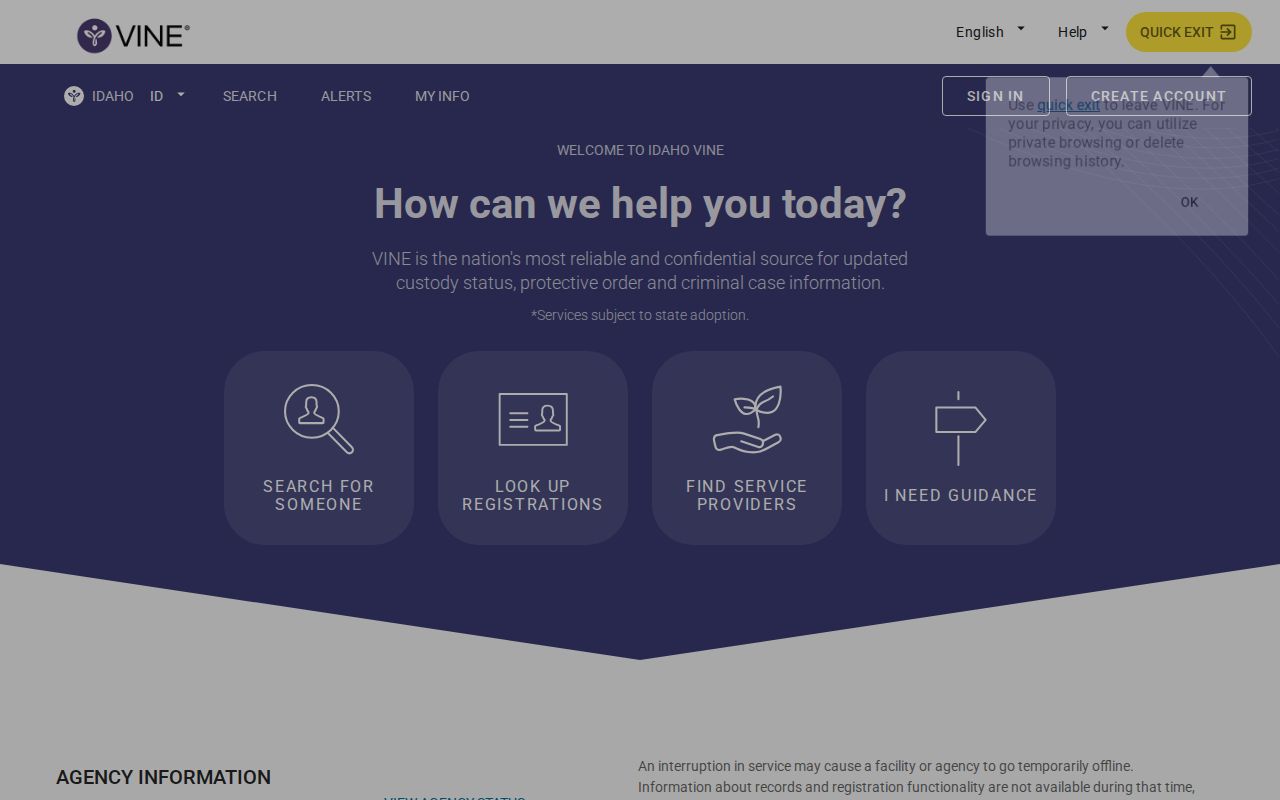
The captured interface illustrates why the exact matched record must drive registration. An alert attached to the wrong namesake is not useful evidence.
Register Caribou Release Alerts
Registration starts from the matched person’s record. Idaho VINE may offer phone, text, email, or a combination. The options can depend on the record and service. Contact information used for the alert is confidential from the tracked person under VINE guidance. Still, keep confirmation details where they can be found later.
- Open the exact matched VINELink record and choose its notification or registration option.
- Select each available channel desired: phone, text, email, or a combination.
- Enter and confirm the destination details.
- For a phone alert, create a memorable four-digit PIN. It confirms receipt and is not the incarcerated person’s PIN.
- Submit the registration and retain the confirmation.
- When an automated call arrives, listen and enter the PIN followed by the pound key.
Unacknowledged calls can repeat every two hours for up to 48 hours. Messages may arrive at inconvenient times. For a forgotten PIN, unwanted calls, or portal help, call Idaho VINE support at 866-984-6343. Operators are available around the clock. IDOC Victim Services also lists 208-605-4774 for agency help with state correctional matters.
Caribou Release Alert Meaning
An alert is a prompt to verify, not the final release record. VINE depends on information entered by the participating agency and passed through its interface. A delay, correction, system outage, or incomplete source entry can affect timing. Idaho Jail Standards recognize that notification depends on jail-management data. Save the event wording, source agency, and time received, then compare it with the source record.
Idaho confirmed that VINE service was active after a restoration announced in March 2024. Older agency material may still contain stale outage language, while the current functioning portal and later IDOC notice reflect the newer state. Even an active service can have a temporary interruption. If an expected alert does not arrive, search the person again, verify registration details through support, and contact the source agency. Do not wait on the alert alone when immediate custody confirmation is needed.
For Caribou County Jail, call the booking desk and ask a narrow question: is the person still physically in Caribou custody, and if not, was the person released to the community or transferred? The jail houses contract prisoners for other Idaho counties and IDOC, so this distinction is especially important. If more detail is needed, use the sheriff’s public-record request for release time, authority, destination, and holds.
For a state correctional matter, compare the event with the IDOC Resident/Client Search. “In community” can show active parole or probation and a Released to Supervision date. “Discharged” means IDOC reports the sentence satisfied. Neither label should be replaced with a guess based on a county roster disappearance.
Why Caribou Endorses VINELink
The Caribou County Sheriff homepage labels VINELink for victims, and the detention page places it beside custody and case information. This repeated placement is the county’s distinctive online path. The same official sweep found no sheriff name roster, booking archive, or 24-hour and 72-hour release feed.
That design makes VINE valuable for a known person and poorly suited to a different question: who left jail today? It is not a browsable historical Caribou County release list. Older events may not remain available as an archive. The written sheriff record is more durable, while iCourt can preserve the case order that led to bond, dismissal, sentence, probation, or commitment.
Use the tool within its actual scope. A missing search result is not proof of release. An explicit event is stronger, but the source agency still controls its own physical-custody record.
Caribou Release Channel Sweep
When VINELink cannot answer the question, move to the system that held the person. For county custody, telephone and written channels remain available even without a sheriff roster. For state custody, IDOC’s public search and records unit are the proper next steps. Court and federal systems have separate roles.
- County jail release
- Call booking, then request the Caribou booking and release record with disposition and receiving agency.
- State release
- Search IDOC, read the exact date labels, and request Sentencing Records when the calculation is disputed.
- Court authority
- Search iCourt for bond, dismissal, judgment, commitment, or probation orders.
- Federal custody
- Use the BOP locator for sentenced federal imprisonment; U.S. Marshals pretrial custody has no equivalent public nationwide locator.
- Immigration custody
- Use ICE’s locator only when a detainer or reliable case information makes that system relevant.
A person can move through more than one channel. Keep release from Caribou County separate from release into the community, and describe the event the records actually support.
For an older event, begin with durable records. VINE is designed for current status and notifications, not permanent public history. Give the sheriff aliases, date of birth, an approximate booking range, and a case number when available. iCourt may explain the disposition long after a live custody event has changed, while IDOC can retain a discharged status after state jurisdiction ends. A shielded court case may be absent from ordinary public results, so a missing screen still cannot substitute for a custodian’s response.
Resolve Caribou Search Conflicts
Conflicting results require reconciliation, not a choice based on which screen appeared first. If VINE says released while IDOC shows “In custody” at a state location, the likely event is release from Caribou County to state custody. If VINE reports release and iCourt shows a bond order, ask booking whether any other hold or transfer remained before describing community release. A court order explains authority, but the jail log supplies the physical exit time.
When IDOC shows “In community,” open the detail record. Parole or probation, a supervising district, and Released to Supervision show that confinement ended while correctional jurisdiction continued. A future Sentence Satisfaction Date is not a new projected jail release. By contrast, “Discharged [date]” means IDOC reports its sentence and jurisdiction satisfied. Obtain the historical record when the precise institution exit predates discharge.
Write down the exact status, event date, date viewed, source agency, identifier, and URL. Also record the scope of a negative result. “No Idaho VINE match found at the time searched” is accurate. “The person was never jailed” is not supported by that search.
Search Public Records
Sponsored Results