
Caribou County Parole Versus Probation
Parole and probation both place a person in the community under rules, but they begin in different ways. The Idaho Commission of Pardons and Parole decides whether an eligible state prisoner may leave confinement on parole. IDOC then administers that supervision. A court orders probation, often as part of a felony sentence, and IDOC supervises felony probationers. Neither status means the underlying case has vanished or the sentence has been satisfied.
| Point | Parole | Probation |
|---|---|---|
| How it begins | Commission grants conditional release during the indeterminate sentence period | Court enters a community-supervision sentence or order |
| Decision source | Commission hearing and action notice | Caribou County court judgment or order |
| Public verification | IDOC record may show In community, Parole, and Released to Supervision | IDOC record may show In community, Probation, and the assigned district |
| End point | Discharge or sentence satisfaction after the required term | Court or IDOC discharge after successful completion |
A Caribou County Jail departure is a separate event. A person can leave the jail on bond with no IDOC supervision, transfer to an IDOC institution while still confined, or enter probation after judgment. The custody record and case order identify which event occurred.
Check Caribou County Post-Release Supervision
The official individual lookup is the IDOC Resident/Client Search. It covers incarcerated residents, parolees, probationers, and people on court probation. It does not cover every county-only booking. Search results update daily, so a recent change may require direct confirmation.
- Search by last and first name or IDOC number. IDOC requires at least two last-name characters or three IDOC-number digits.
- Match the full name, birth year, and IDOC number before opening a detail record.
- Read the headline status. In community means outside IDOC confinement but still within active jurisdiction. Discharged followed by a date means the IDOC sentence has been satisfied.
- Check the sentence row for Parole or Probation, Released to Supervision, and Sentence Satisfaction Date.
- Record the supervising district, officer, office, and phone when displayed. Verify that routing before contacting an office.
- Compare the result with the Idaho iCourt Portal when the court order, judgment, warrant, or discharge event matters.
These fields answer different questions. Released to Supervision is a historical placement date. Sentence Satisfaction Date is the scheduled full-term endpoint. It is not necessarily the day confinement ended. The status and sentence type together provide the clearest public view.
The public detail interface also lists the sentencing county, case number, offenses, and sentence status. Those fields help distinguish a Caribou case from a namesake. Save the date viewed because IDOC warns that status and scheduled termination information can change. When the public result is incomplete, use the IDOC records portal to request the underlying correctional record or a correction.
The official IDOC interface shows how community supervision appears. The image below comes from an example record used only to explain fields, not to claim that the pictured record concerns a Caribou County release.
View the IDOC example detail source before comparing its labels with a live search.
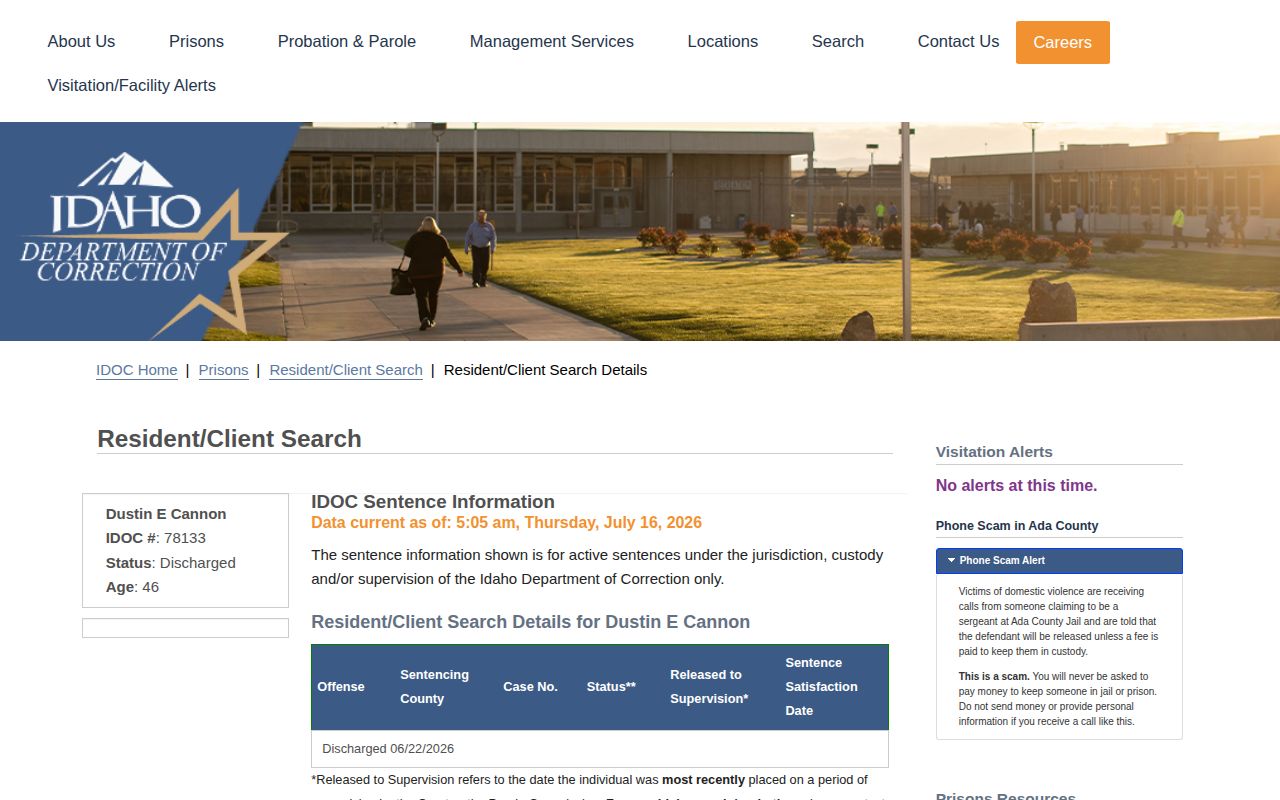
The supervising office, Released to Supervision, and sentence fields shown there illustrate why one label alone cannot answer every release question.
Caribou County Supervision Contacts
IDOC District 6 serves Caribou County from Pocatello and also maintains a Soda Springs satellite. The local site is a supervision office, not a jail, halfway house, or release counter. Assignments can change. Use the live IDOC detail record before choosing which office to call.
IDOC District 6
Main office: 1246 Yellowstone Avenue, Suite F, Pocatello, ID 83201-4310
Phone: 208-237-9194
Soda Springs satellite: 159 South Main, Soda Springs, ID 83276
Phone: 208-547-1813
Fax: 208-237-2646
Public staff may confirm office routing within disclosure limits, but reporting times and case-specific instructions must come from the assigned officer. Court clerks at the same South Main address maintain court records, not supervision files.
Caribou Supervision Warrants and Violations
Conditions are the rules attached to parole or probation. They may address reporting, travel, programs, payments, or other case-specific duties, but the complete terms are not exposed through a simple public status page. A violation allegation can lead to review, a warrant, arrest, or a parole-revocation hearing. It does not prove that the person is currently jailed.
An IDOC result may show Active Bench Warrant. Caribou County has no verified public absconder list, so confirm that label with IDOC or the relevant court before relying on it. A stale record cannot establish a current location. The Commission's hearing schedule may list a parole-revocation hearing, while its action notice may show revocation, reinstatement, continuation, or another result.
VINE can notify a registered user about jail or IDOC custody changes, but it is not a supervision-condition database. A transfer alert means one agency's custody ended. It does not establish release to the community.
When Caribou County Supervision Ends
Supervision ends only through an authorized discharge, sentence satisfaction, or court action. Completing a reporting period is not something a reader should infer from elapsed time. IDOC may retain a result reading Discharged with a date while no longer displaying conviction details. That is stronger evidence that IDOC jurisdiction ended than an In community label, which signals active correctional jurisdiction.
Idaho Code section 19-2604 may allow qualifying relief after successful probation, but dismissal or set-aside relief is not the same as erasing every agency record. Clean Slate shielding and criminal-history expungement also have distinct rules. For the underlying court disposition, consult iCourt or the clerk. For the physical jail departure and its exact time, use the release-record process described on the Caribou County released inmates search.
Where Caribou Parolees Report Locally
The Soda Springs satellite at 159 South Main gives assigned clients a local IDOC contact instead of requiring every routine contact to begin in Pocatello. This local presence is useful, but it should not be mistaken for a residence or reentry center. A released person does not live there, and the office does not hold inmates.
The IDOC record remains the routing source. It can display District 6, the supervising officer, an office address, and a phone number after release. Call the office shown on that live result. Reporting and check-in directions come from the officer, not from a general public page or an assumed county assignment.
Caribou Parole Decisions Versus Release
The Commission publishes weekly calendars and Notices of Action Taken. A calendar entry shows that a hearing is planned, not that parole will be granted. A grant may carry a tentative parole date, but IDOC programs, paperwork, and an approved parole plan still must be complete. The Commission warns that nobody is released before the tentative date.
After that date, check IDOC for In community, Parole, and Released to Supervision. If the public pages conflict or omit needed detail, request Commission summary minutes through its public-information process and request IDOC sentencing or release records. A Commission decision predicts or authorizes a path. The later IDOC status confirms whether state confinement actually ended.
The distinction matters in Caribou County because the local jail holds some IDOC contract prisoners. Leaving the county building may be a state transfer. It does not itself prove parole.
Public Record Search
Sponsored Results