
No Caribou Mugshot Roster
As of the July 16, 2026 research sweep, the official Caribou County detention page contained no searchable photo roster, recent-release gallery, booking archive, or released-photo page. Its “Inmate Information” route leads to a descriptive jail page. The sheriff instead points people toward VINELink and court information for custody and case questions.
This negative finding controls the local search. There is no official set of tiles to browse and no county photo feed to reproduce. The absence of a web image also says nothing about whether an agency retains a booking photograph. It means the direct public path is a records request tied to a known booking event.
Request Caribou Release Mugshots
Use the Caribou County Sheriff public-record form and name the photograph expressly. A broad request for “release information” may not automatically include the image. Provide enough detail for staff to locate the booking without mixing the person with a namesake.
- Give the full legal name and any known date of birth or alias.
- Provide the booking number, booking date, case number, or a narrow date range when known.
- Ask for “the booking photograph associated with booking number/date.”
- Request the booking and release fields separately if custody status must also be verified.
- Ask for electronic delivery and a cost estimate before work begins.
- If material is withheld, ask for the exemption and whether a redacted record can be released.
The useful release fields include the exact exit time, release authority or type, holds, and destination or receiving agency. These fields matter because Caribou County Jail houses contract prisoners for other counties and IDOC. A photograph may be from Caribou booking even when the person later transferred to another custodian.
Caribou Photo Request Details
The sheriff front office is reached at 208-547-2561 and can route a records question. The jail is at 475 East 2nd South in Soda Springs, but no official page promises public records-counter hours. Call before visiting. Booking staff at 208-547-3094 can address immediate physical-custody questions, although a written record is the durable route for an image and exact disposition.
| Request item | Why include it |
|---|---|
| Full name and identifiers | Reduces the chance of retrieving a namesake’s booking. |
| Booking number or date | Ties the image to one event rather than every record for a person. |
| Booking photograph | Names the image that a general release request may omit. |
| Release date and time | Documents when Caribou custody ended. |
| Disposition and authority | Explains bond, completion, dismissal, court order, or another basis. |
| Destination or receiving agency | Separates community release from transfer. |
Idaho’s Public Records Act sets response and fee rules, but no local fee schedule was published. Qualifying resident requests generally receive a response within three working days or notice of an extension up to ten working days. Nonresident extensions can reach 35 days under current guidance. Ask for a current estimate rather than assuming the photo is free.
Caribou Mobile Photo Limits
No Caribou-specific sheriff mobile app or operational social mugshot feed was verified. Generic sharing controls in an official footer are not agency social accounts. The statewide Idaho Sheriff Connect listing advertises jail information in broad terms, but no official Caribou source established county participation or a local release-photo function.
The sheriff’s Latest News archive is historical rather than a systematic booking stream. A press release may carry an image for a particular public event. That makes it a case-specific source, not a complete list of people booked or released. Check the publication date, caption, and originating agency before linking an image to a booking.
Do not infer a hidden mobile feed when the county has documented none. Search the named booking through records instead. This keeps the photo tied to an official event and avoids confusing generic statewide app functions with Caribou County practice.
IDOC Caribou Photo Records
A county booking image and an IDOC correctional image are not interchangeable. Someone can be photographed at Caribou County Jail, later enter state custody, and have a separate correctional image. The public IDOC detail pages reviewed did not visibly expose a portrait as a standard field, so no claim should be made that every Resident/Client Search record includes a photo.
Start with the IDOC Resident/Client Search to verify whether the person belongs to the state system. It supports last name, first name, and IDOC number searches. A detail result can show “In custody,” “In community,” or “Discharged,” plus sentence and supervision data. Those fields establish scope and status, not necessarily image access.
Request a public state correctional image through the IDOC JustFOIA portal. Identify the person and IDOC number, and state which image or event is sought. IDOC may apply correctional safety, privacy, and other exemptions. Even when released, an IDOC image is not proof of the Caribou booking photo.
Registry Photos Have Narrow Scope
The Idaho State Police Sex Offender Registry may display a photograph for a person legally required to register. It is not a general mugshot repository. Most released people do not belong in it, and the presence of a record cannot establish the date or reason for a Caribou County jail release.
The official registry search carries its own warnings and scope rules.
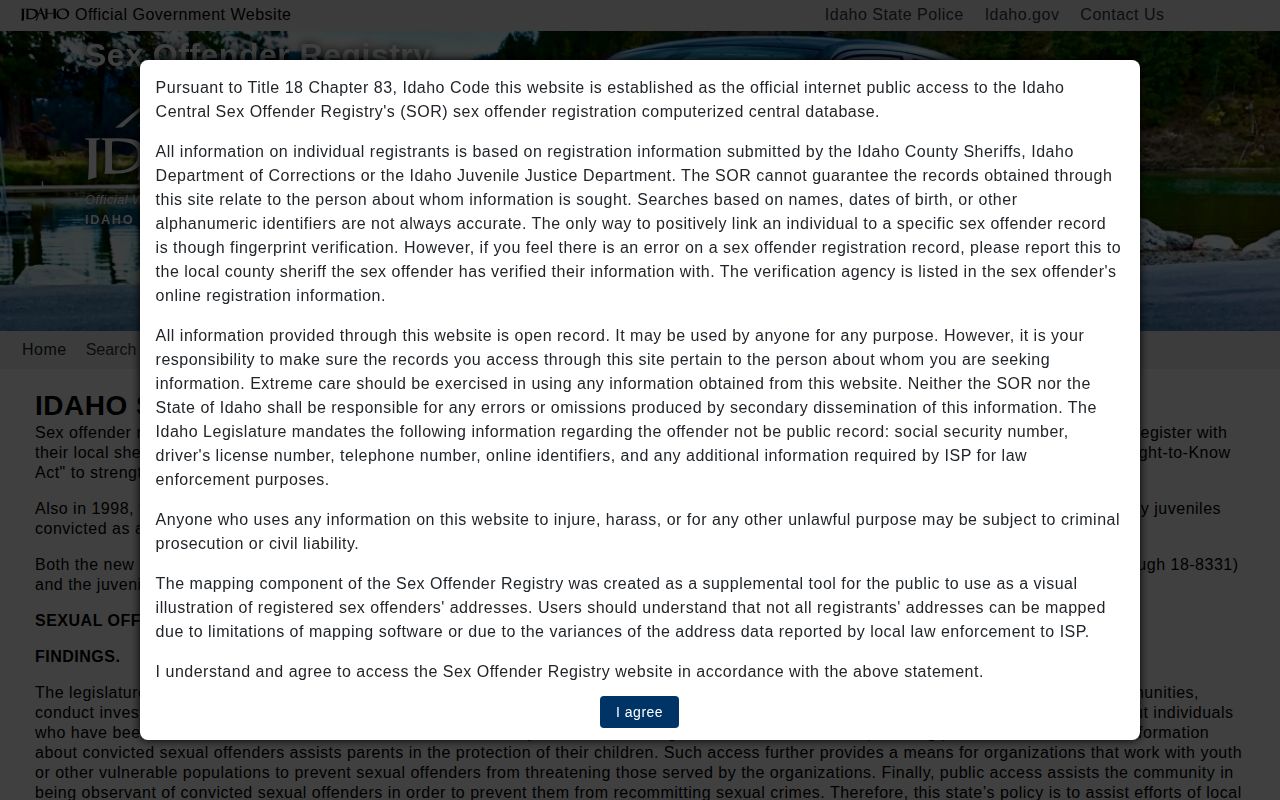
The interface illustrates that this source applies only to qualifying registrants. Use name and geographic fields within that lawful scope, follow its anti-harassment and misuse restrictions, and never treat absence as evidence about an ordinary released person.
Verify Caribou Photo Identity
A useful photo check connects four items: person, booking event, image source, and custody evidence. Similar names and reused photographs are common sources of error. Save the source URL, publication date, stated booking date, agency, and any number printed with the image. Compare them with the official booking or case record.
- Confirm that the source names Caribou County or the actual booking agency.
- Match a booking number, date, case number, or other event detail.
- Check whether the image is original agency material, a news copy, or an aggregator copy.
- Use VINELink, booking staff, or a release record for custody status.
- If the image conflicts with the record, rely on the originating agency and request clarification.
A commercial booking page can serve only as a lead for an approximate booking date. Its continued display does not mean custody, and disappearance does not mean release. Commercial captions, dates, edits, and identity links can be stale or wrong. The Caribou County released inmate search supplies the official status and record sequence.
Caribou Photo Access Law
Booking-photo requests proceed under Idaho’s general Public Records Act, Title 74, chapter 1, and its exemptions. Idaho Code § 74-124 can protect law-enforcement investigatory material when disclosure would interfere with enforcement, invade privacy, reveal a protected source or method, impair a fair trial, or endanger someone. Juvenile, sealed, shielded, medical, victim, safety, and other protected information may also be withheld or redacted.
No current Idaho statute specifically banning mugshot publishers’ pay-to-remove practices was verified. A 2022 proposal is not enacted law and should not be cited as one. That does not make every image automatically public. The custodian must review the actual record and legal limits. If access is denied, ask for the cited basis, appeal information, and any separable portion that can be produced.
- Booking photograph
- An image created in connection with a custody booking.
- Redaction
- Removal of protected information while releasing the rest of a record.
- Sealing or shielding
- Legal restrictions on public court access; neither term means every independent copy was destroyed.
- Expungement
- A statutory remedy with defined eligibility and effect, not a universal deletion command.
Clean Slate Photo Effects
Idaho Clean Slate relief shields qualifying court records rather than erasing every trace. The waiting period generally begins after the whole sentence is complete, including supervision, fines, and restitution, and eligibility is limited. A shielded public iCourt record may disappear from ordinary view while justice-system access remains.
Idaho Code § 19-2604 can permit set-aside or dismissal relief in qualifying cases. Section 67-3004 addresses defined criminal-history expungement and Clean Slate shielding routes. Their effects differ. Neither supports the claim that every jail, news, registry, agency, or copied image vanishes automatically.
Therefore, no public iCourt result cannot be translated into “no case” or “never released.” Ask the record custodian what can be disclosed now. Keep old images tied to the date and source that produced them, and do not state that a past image reflects current legal status.
Every Caribou Photo Channel
The channel sweep is short because the county publishes no gallery, but it still includes every documented route.
- Sheriff request: primary route for the Caribou booking photograph and release disposition.
- Sheriff phone or visit: call first because no records-counter hours are promised online.
- IDOC request: for a state correctional image, not an assumed duplicate of the jail photo.
- Registry: only for a qualifying statutory registrant and never as general release proof.
- Official news: case-specific images with date and provenance, not a systematic archive.
- Commercial page: an unverified lead for a booking date, never authoritative release evidence.
- Court and VINE: status and case corroboration; neither is the primary county photo archive.
Keep the image question separate from the release question. Request both records when both facts matter. A photo identifies a past event; the source agency’s release record identifies what happened at the end of custody.
Search Public Records
Sponsored Results