
Caribou Release Dates Differ
A pretrial detainee often has no set release date. Release may depend on bond, dismissal, a new court order, case resolution, or another hold. A person serving a county sentence may have a commitment with a calculated end, but the public Caribou County website supplies no release calculator or local good-time policy. Ask the jail and court for the actual calculation rather than counting calendar days.
An IDOC sentence uses different records. Idaho’s public Resident/Client Search exposes named date fields, but none is literally labeled “Projected Release Date” or “Tentative Release Date.” Parole Eligibility Date, Sentence Satisfaction Date, Released to Supervision, and a Commission tentative parole date answer distinct questions. Changing those labels to fit a generic projected-date idea creates a false result.
Find Caribou Projected Release
First identify who holds the person. The Caribou County Jail houses local detainees as well as contract prisoners for other counties and IDOC. A date tied to one agency may cease to control after transfer. The most reliable search follows the custody path and ends with confirmation from the agency that performs the release.
- Determine whether the person is at Caribou County Jail, in IDOC custody, in another county, or in a federal or immigration system.
- For a county case, call booking at 208-547-3094 and ask whether a sentence calculation or pending court authority exists.
- Search Idaho iCourt for the Caribou case order, sentence, amendment, bond, dismissal, warrant, or hold activity.
- For state jurisdiction, use the IDOC Resident/Client Search by last name, first name, or IDOC number.
- Read each displayed date by its exact title. Do not turn eligibility or satisfaction into an assured exit day.
- If a parole grant is involved, review the Commission notice and its stated conditions.
- After the expected date, confirm actual status through IDOC, VINE, or the source agency’s release record.
A public search can narrow the question. When dates conflict, request the official calculation. For state sentences, IDOC Sentencing Records applies judgment terms, jail credit, retained-jurisdiction credit, and parole adjustments. For a county-only sentence, obtain the jail calculation and relevant court order.
Idaho Release Date Fields
IDOC results cover incarcerated residents, probationers, parolees, and people on court probation. Search results show identity and status, while the detail record may show sentence and supervision fields. IDOC says the database updates daily and warns that location, status, and scheduled termination information can change quickly.
| Official field | Correct reading |
|---|---|
| Parole Eligibility Date | Earliest point for parole consideration, not promised release. |
| Commission tentative parole date | A conditional future date after a grant; required programs, plan approval, and paperwork still control. |
| Sentence Satisfaction Date | Scheduled full-term endpoint, not necessarily physical prison exit. |
| Released to Supervision | Historical date of the most recent placement on supervision, not an estimate. |
| Discharged [date] | IDOC reports the sentence and its jurisdiction satisfied. |
The official IDOC detail example displays a Parole Eligibility Date and explains the timing of an initial hearing.
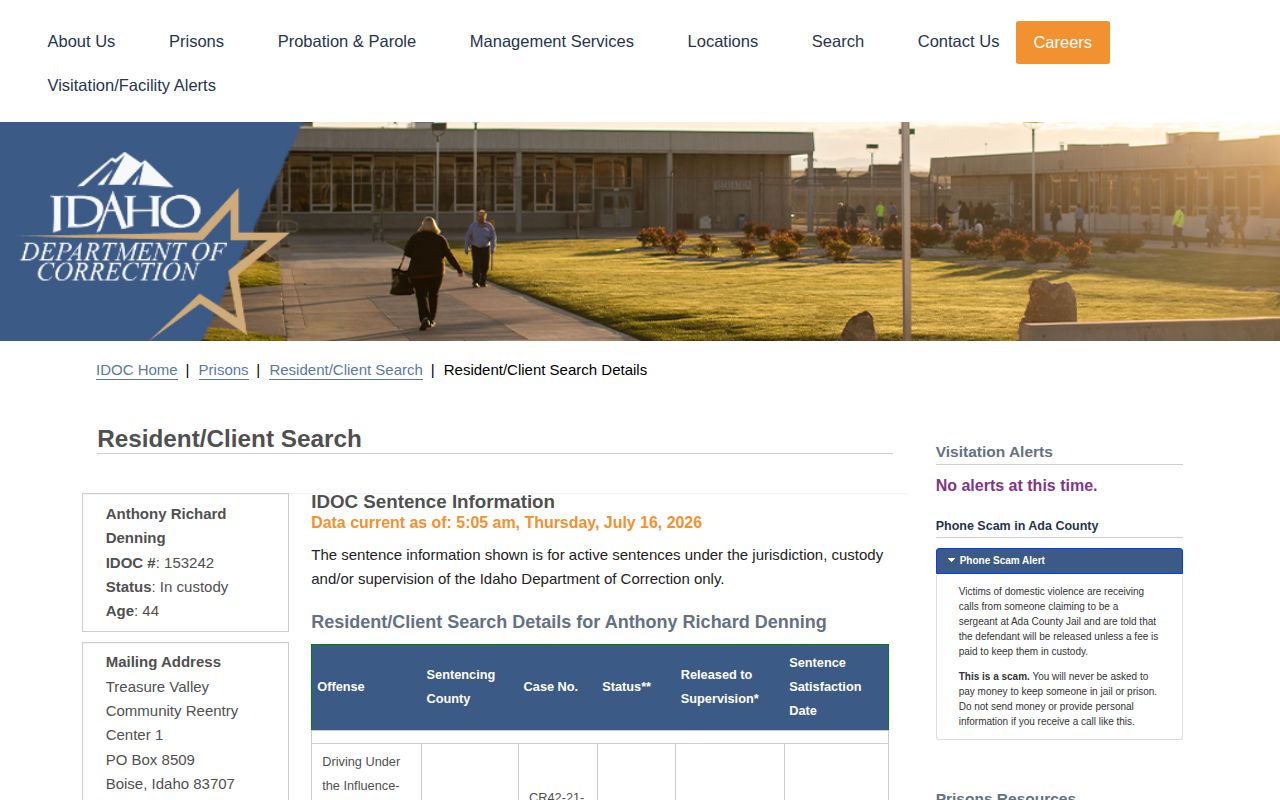
The image preserves the state’s own wording. It demonstrates why a PED should never be presented as a scheduled jail-door release.
Caribou County Sentence Dates
For a county-jail term, start with the commitment order and the jail’s calculation. Credit for time already served can affect the end. Concurrent sentences run together, while consecutive sentences run one after another. Contempt commitments, amended orders, a new warrant, or a hold can also change when a person physically leaves Caribou custody.
The sheriff publishes no county-specific good-time formula, release calculator, weekend rule, or promised processing schedule. Idaho Code § 20-101A contains an older county-jail good-conduct schedule where applicable, but it should not be imported into every case or used as a general rule for a modern IDOC unified sentence. Ask how credit was actually applied.
Use the sheriff’s records form for the commitment and release calculation when a phone answer is not enough. Give the person’s identifiers, booking range, and case number. Request electronic delivery and a cost estimate. No sheriff records hours or local fee schedule was published, so call before an in-person visit.
Idaho Fixed Minimum Rules
Idaho does not use a general rule that every sentenced person serves 85 percent. Under Idaho Code § 19-2513, a unified sentence states a minimum determinate term and may add an indeterminate term. The determinate part is the fixed minimum. A modern felony prisoner generally cannot receive parole, discharge, or routine good-conduct reduction during that term.
Once the fixed portion ends, the Parole Eligibility Date marks the start of possible Commission consideration during the indeterminate portion. Eligibility is not a right to release. Mandatory minimums, fixed life, death sentences, and other statutory limits can bar ordinary parole. Commission discretion also matters. The current framework includes Idaho Code § 20-1005, while § 20-223 and § 19-2513 remain central to understanding eligibility.
- Determinate term
- The fixed minimum period of an Idaho unified sentence.
- Indeterminate term
- The later portion during which parole may be considered.
- Parole
- Conditional release before sentence satisfaction, with IDOC supervision.
- Detainer
- A request or hold that can keep or transfer a person despite another release authority.
Caribou Earned-Time Limits
Routine program completion should not be described as automatically reducing an Idaho determinate term. Idaho Code § 20-101D concerns extraordinary meritorious service, not ordinary earned time. It permits a limited reduction for rare acts such as risking life in heroism, saving lives, preventing major property loss during a riot, or preventing escape. Medical parole under § 20-1006 is also a narrow, separate path.
This distinction matters when someone tries to calculate a Caribou County projected release date from sentence length alone. The public record may not reveal all credits, forfeitures, sentence relationships, holds, or corrections. Simple arithmetic can be wrong even when the court judgment is known. Request the calculation if the date has practical importance.
For state custody, the IDOC Sentencing Records unit is the authority on those calculations. IDOC records can also be requested through its JustFOIA route. For local custody, the Caribou jail and clerk hold separate pieces: jail staff document physical custody, while the court file supplies the legal order.
What Changes Caribou Release
A projected date can move earlier or later for lawful, case-specific reasons. Some factors change the sentence calculation. Others leave the sentence intact but delay the physical exit or move the person into another agency’s custody.
| Factor | Possible effect | Best source |
|---|---|---|
| Jail or retained-jurisdiction credit | Changes the credited time in the official calculation. | IDOC Sentencing Records or jail calculation |
| Concurrent or consecutive terms | Changes how multiple sentences run. | Judgment and sentencing record |
| Court amendment or correction | Replaces or adjusts the controlling order. | iCourt and clerk copy |
| Parole grant or denial | May create a conditional date or continue confinement. | Commission decision notice |
| Programs and parole plan | Can prevent final parole release by a tentative date. | Commission and IDOC record |
| Hold or detainer | Can delay community release or cause agency transfer. | Jail release disposition |
| Calculation correction | Can revise a date shown earlier. | Sentencing Records |
Never assume that leaving the Caribou County Jail means entering the community. Its contract population includes IDOC and other-county prisoners. Ask for the receiving agency or destination field.
Caribou Parole Date Check
The Idaho Commission of Pardons and Parole publishes a hearing schedule and Notices of Action Taken. A notice may show grant, denial, deferment, continuation, rescission, revocation, reinstatement, or another precise outcome. Preserve that wording. A hearing date is planning evidence, and a grant is not actual release.
The Commission warns that no incarcerated person leaves before the reflected tentative date. Required programs and an IDOC-approved parole plan must be complete before finalization. Other paperwork or custody issues can remain. After the date, search IDOC for “In community,” parole status, and Released to Supervision, or request the actual state release record.
Compare the later status with a person-specific alert from VINELink Inmate Search. VINE can report movement or release, but exact state sentence calculations remain with IDOC. The full Caribou County release record path explains how court and agency records work together.
Every Caribou Date Channel
A complete date check includes online, telephone, written, and in-person alternatives. This channel sweep prevents a failed public search from becoming a false claim that no date exists.
- County online: iCourt for the order and VINELink for a person-specific custody event; there is no sheriff roster.
- County telephone: booking at 208-547-3094 for current custody and release-versus-transfer confirmation.
- County written: sheriff public-record request for release time, authority, holds, destination, and local calculation.
- State online: IDOC search for exact official fields and Commission pages for conditional parole action.
- State written: Sentencing Records and JustFOIA when the displayed date is disputed or incomplete.
- Court: Caribou clerk records for the judgment, commitment, amended order, bond, dismissal, or warrant.
- Federal or ICE: use BOP or ICE only when that separate custody system is genuinely involved.
An in-person county inquiry begins at the jail or clerk that holds the needed record, but neither office should be assigned hours published for a different county function. Call before travel. The court can furnish the legal order; it cannot create the jail’s physical release timestamp. Likewise, jail staff can explain custody and a local calculation but cannot replace the Commission or IDOC on a state parole date.
If the person is in federal custody, the BOP locator may display a release date for a sentenced federal prisoner. It does not cover all pretrial U.S. Marshals custody. ICE’s locator concerns current immigration detention and is not a historical release calculator. A Caribou case origin does not make either federal system part of IDOC, so use them only when the record points there.
Keep an event date separate from the date viewed. Save the exact label, source agency, case or IDOC number, and any update warning. Then confirm the physical release after it occurs.
Search Public Records
Sponsored Results