
Understanding Caribou County Released Inmates
“Released” means custody held by a particular agency ended. It does not always mean a person returned home. A jail may release someone on bond, after time served, on a court order, to probation, or into another agency’s custody. State prison release may place a person on parole, while a later discharge ends IDOC jurisdiction. A transfer to another county, IDOC, the U.S. Marshals Service, BOP, or ICE is a departure from Caribou custody but not community release.
That distinction determines where to look next. County jail activity belongs with the sheriff; case authority belongs with the court; state custody and supervision belong with IDOC and the Commission of Pardons and Parole. Federal sentenced-prisoner information belongs with BOP. Each record is evidence of its own action, not a substitute for all the others.
Ways People Leave Caribou County Custody
| Type | Meaning | Next source |
|---|---|---|
| Bond or court release | Jail processes valid authority, subject to other holds. | Booking/release record and iCourt. |
| Time served or sentence end | The commitment is satisfied after applicable credit and calculation. | Jail record, commitment, and court order. |
| Transfer | Caribou custody ends while another agency receives the person. | Destination field, receiving jail, IDOC, BOP, or ICE. |
| Parole or probation | Community placement carries conditions and an assigned office. | IDOC client record and District 6. |
| Dismissal or acquittal | A court resolves charges, but jail processing and other holds still control departure. | iCourt plus the jail release timestamp. |
| Discharge | IDOC jurisdiction or the sentence has ended. | IDOC status and records. |
What a Caribou County Release Record Shows
The release record ties the physical exit to a particular booking. It is the central county source when no public roster or recent-release feed exists.
| Field | What it shows |
|---|---|
| Name and booking number | The person and jail event being documented. |
| Admission date/time | When the relevant custody period began. |
| Physical release date/time | When Caribou jail custody ended. |
| Authority and type | Bond, court order, time served, transfer, or another disposition. |
| Bond status and holds | Why release may have followed later than payment or court action. |
| Destination | Community release or the receiving agency. |
| Booking photo | An associated image only when expressly requested and lawfully disclosed. |
Request a Caribou County Release Record
- Open the sheriff’s electronic public-record form.
- Supply name, contact details, a focused description, delivery preference, and electronic signature.
- Identify the full name, approximate booking date, booking number if known, and the exact fields needed.
- Ask for electronic copies, an advance cost estimate, and the retention series if no responsive record is found.
- Request the booking photograph explicitly rather than assuming it comes with the release entry.
The sheriff lists 475 East 2nd South, Soda Springs, ID 83276; front office 208-547-2561; fax 208-547-0252; and booking 208-547-3094. No official records-unit hours, dedicated records email, local copy rate, fixed response estimate, or release-record retention period was found. Do not assign the court’s office hours to sheriff records.
Idaho Law and Caribou County Release Records
Idaho’s Public Records Act, Title 74 chapter 1, favors access subject to statutory exemptions. Qualifying resident requests generally receive a grant or denial within three working days or notice extending the response up to ten working days; a nonresident extension can reach 35 days. Qualifying residents receive the first two labor hours and 100 paper pages without charge before actual-cost provisions apply. Current law should be checked when requesting.
Investigatory records may be withheld or redacted where disclosure would interfere with enforcement, impair a fair trial, invade privacy, reveal sources or techniques, or endanger someone. Juvenile, sealed, shielded, medical, victim, and security material can also be restricted. A denial should identify its legal basis and appeal information.
How to Find a Released Caribou County Inmate
- Start with Idaho VINELink, the online custody-change service linked by the sheriff.
- Call booking for current status and release-versus-transfer confirmation.
- Search IDOC by name or IDOC number if state custody or supervision is possible.
- Review iCourt for the judicial disposition or release authority.
- Use BOP, PACER, ICE, or the receiving county when the record points beyond local custody.
- Request the official release entry when an exact timestamp and disposition are needed.
For very recent events, see Jail Releases: 24 Hours or the wider Jail Releases: 72 Hours. Neither page simulates a county feed that does not exist.
IDOC Search for Caribou County Released Inmates
The Idaho Department of Correction resident and client search accepts a last name with optional first name and IDOC number. Results can distinguish incarceration, community supervision, and discharge. Detail fields may include supervising office, “Released to Supervision,” sentence satisfaction date, parole eligibility information, and hearing notes. A public result is a locator, not a complete sentencing calculation.
| Public term | Read it as |
|---|---|
| In community | The person is not shown in an IDOC institution and may be supervised. |
| Released to Supervision | A historical community-placement date, not a future estimate. |
| Sentence Satisfaction Date | The scheduled full-term endpoint, not necessarily the jail exit. |
| Discharged | IDOC jurisdiction or sentence completion as reported. |
| Parole Eligibility Date | Earliest consideration point, not a promised release. |
The official IDOC search interface shows the available name and number fields.
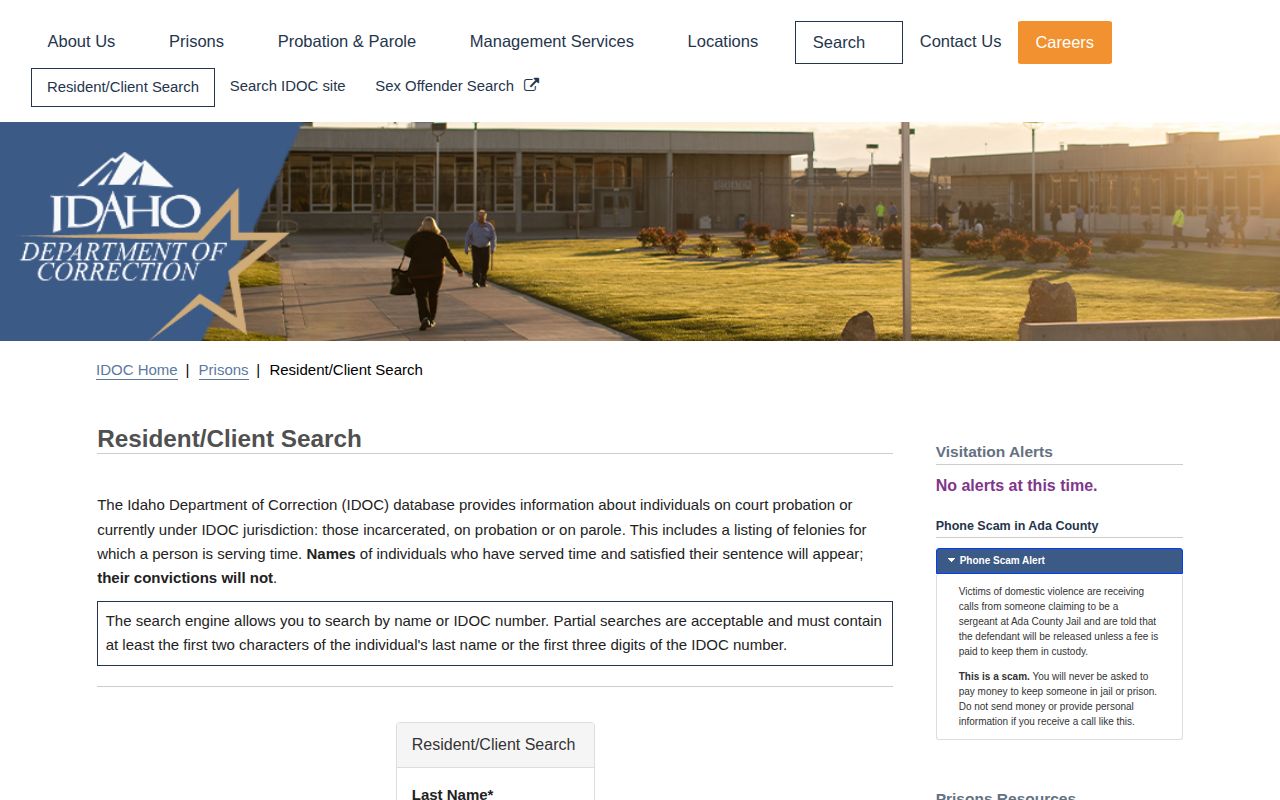
The search form supports a focused statewide follow-up when a Caribou release record indicates IDOC custody or supervision.
No Caribou County Recent-Release Roster
As of July 16, 2026, the sheriff published no searchable jail roster, 24-hour or 72-hour release list, feed field definitions, update cadence, or archive retention. The official detention page instead directs custody questions toward VINELink and court information. VINE can report a matched person’s release or transfer event and support notifications, but it is not the sheriff’s historical release archive.
Does Online Bond Payment Complete a Caribou County Release?
No. The detention page links an online court and bond payment service, but payment is not the physical release event. Court acceptance, jail processing, other warrants, detainers, and holds remain controlling. No county bond schedule, pretrial-services office, or promised processing time was located. Confirm the actual timestamp through booking or the release record.
Local Supervision After a Caribou County Release
IDOC maintains District 6 at 1246 Yellowstone Avenue, Suite F, Pocatello, 208-237-9194, and a Soda Springs satellite at 159 S Main, 208-547-1813. The local office is a supervision contact, not a detention facility or reentry residence. Verify the assigned office from the live IDOC record before calling. The Probation & Parole guide explains the separate roles of IDOC and the Commission.
Caribou Court and Supervision Records at 159 S Main
The courthouse and IDOC Soda Springs satellite share the same listed street address, which can help organize a local follow-up. Their authority remains separate. The clerk supplies judicial orders and case documents; IDOC verifies supervision. Neither substitutes for the jail’s physical release log. Because official directory phone listings conflict, use court general information at 208-547-2146 or verify the number before relying on it.
Was the Person Released or Returned to Another Agency?
Caribou County Jail has 49 beds for men and women across minimum, medium, and maximum settings. It also houses contract prisoners for other Idaho counties and IDOC. That makes roster disappearance unusually ambiguous. Ask for the receiving agency and destination rather than assuming community release.
Can Clean Slate Hide a Caribou County Court Record?
Idaho Clean Slate relief shields qualifying court records from public view rather than destroying every independent record. A petition generally follows five years after the entire sentence, including supervision, fines, and restitution, and eligibility is limited. Authorized court and justice-system access remains, and only one petition may be granted in a lifetime. A missing iCourt result therefore does not prove that no case or release occurred.
VINE, BOP, and ICE Release Checks
VINE covers participating Idaho jail and IDOC events, not BOP, USMS, PACER, or ICE. BOP’s locator covers federal inmates from 1982 forward and updates daily; a past release date means departure from BOP custody, not necessarily freedom from all custody or supervision. ICE ODLS can include people currently detained or recently in ICE custody, reportedly within 60 days, but a miss does not prove community release. A county entry saying “released to ICE” means departure from county custody only.
Released or Still in Custody: Where to Look
| Source | Best use |
|---|---|
| Caribou booking | Current county custody, physical release time, transfer destination. |
| VINE | Person-specific Idaho status, event, and alerts. |
| IDOC | State incarceration, community supervision, release, or discharge. |
| iCourt | Judicial action and case disposition, not jail exit time. |
| BOP/PACER | Sentenced federal custody and federal court orders. |
| ICE ODLS | Current or recent ICE custody when immigration transfer is indicated. |
Facilities Serving Caribou County Release Searches
Build a Reliable Caribou County Release Timeline
A strong conclusion records what each source actually proves. Begin with identity: full name, approximate age or date of birth when appropriate, booking number, IDOC number, and the agency attached to the result. Names alone can produce false matches. Then place each event on its own line. A court order, bond payment, VINE alert, jail departure, admission to another agency, release to supervision, and final discharge can all occur at different times.
Keep the original wording. “Transfer,” “released to supervision,” “parole eligible,” “tentative parole date,” “sentence satisfaction,” and “discharged” are not interchangeable. A Commission grant remains conditional on required programming and an approved parole plan. A future BOP release date can change. An ICE locator miss may reflect timing or an older event. When two sources conflict, contact the office responsible for the disputed fact and request the underlying record rather than choosing the more convenient answer.
For county custody, the sheriff’s physical release time and destination are decisive. For the legal basis, obtain the clerk’s order. For state sentence calculation or correction of a public result, use IDOC JustFOIA and ask for the calculation, release or discharge documentation, and relevant supervision dates. Commission decision records and summary minutes are requested from the Commission. This division of responsibility prevents court staff, probation staff, or a notification vendor from being treated as the keeper of a record they did not create.
Finally, preserve the date checked because live systems change. Public access does not authorize harassment, prohibited registry use, or compilation into mailing and telephone lists.
Search Public Records
Sponsored Results